Notícias
Notícias
 Divulgação médico veterinária. Noticias, artigos, fotos, imagens, vídeos, Petclube é o melhor site que vende cães bulldog, pug, rhodesian ridgeback, frenchie bulldog, chihuahua, buldogue campeiro, olde english bulldogge, pitmonster, gatos ragdoll, maine coon , bengal, exotico, persa, com anúncios de divulgação de filhotes de cachorros e gatinhos munchkin toy raríssimos para todo Brasil
wthats 55 11 9386 8744 Juquitiba SP
PETCLUBE INSTITUTO DE MEDICINA INTEGRATIVA E BIOTECNOLOGIA VETERINÁRIA
PEPTÍDEOS BIORREGULADORES NA MEDICINA VETERINÁRIA INTEGRATIVA
Uma Análise Comparativa das Abordagens Russa e Chinesa e sua Sinergia com a Nutrição Regenerativa e o Sistema Endocanabinoide
Autores: Dr. Cláudio Amichetti Júnior (CRMV-SP 75.404 VT); Dr. Gabriel Amichetti (CRMV-SP 45.592 VT)
Afiliação: Petclube – Medicina Veterinária Integrativa, São Paulo, SP, Brasil.
19 de junho de 2026
1. Resumo (Abstract)
O presente artigo analisa a aplicação clínica de peptídeos biorreguladores na medicina veterinária integrativa, contrastando as escolas russa e chinesa. A abordagem russa, fundamentada nas pesquisas de Vladimir Khavinson, foca em peptídeos de cadeia curta extraídos de tecidos bovinos jovens para modulação epigenética. A abordagem chinesa utiliza peptídeos bioativos derivados da farmacopeia tradicional, como o chifre de veado e fungos entomopatogênicos, visando a regeneração tecidual e o suporte adaptogênico. Discute-se a sinergia desses compostos com a nutrição regenerativa (BPC-157) e o sistema endocanabinoide (SEC) na busca pela homeostase sistêmica em pacientes geriátricos e imunocomprometidos.
This article analyzes the clinical application of bioregulatory peptides in integrative veterinary medicine, contrasting the Russian and Chinese schools. The Russian approach, based on Vladimir Khavinson's research, focuses on short-chain peptides extracted from young bovine tissues for epigenetic modulation. The Chinese approach utilizes bioactive peptides derived from traditional pharmacopeia, such as deer antler and entomopathogenic fungi, aiming at tissue regeneration and adaptogenic support. The synergy of these compounds with regenerative nutrition (BPC-157) and the endocannabinoid system (ECS) is discussed in the pursuit of systemic homeostasis in geriatric and immunocompromised patients.
2. Introdução
A medicina veterinária contemporânea atravessa uma mudança de paradigma, migrando de uma abordagem puramente reativa para modelos regenerativos e integrativos. Nesse cenário, os peptídeos biorreguladores emergem como ferramentas de precisão para a restauração da função celular. Historicamente, a Rússia consolidou-se na vanguarda desta ciência através do legado de Ivan Pavlov e, posteriormente, de Vladimir Khavinson, que desenvolveu a teoria da biorregulação peptídica no Instituto de Biogerontologia de São Petersburgo. Paralelamente, a Medicina Tradicional Chinesa (MTC), com milênios de observação empírica, agora valida seus compostos através da biotecnologia moderna, isolando peptídeos de fontes naturais com alto potencial osteogênico e imunomodulador. A integração dessas terapias visa não apenas tratar sintomas, mas modular a expressão gênica e a homeostase tecidual.
3. Peptídeos de Origem Russa: A Escola de Khavinson
Os biorreguladores russos são caracterizados por serem oligopeptídeos de cadeia curta (2 -44 aminoácidos) extraídos de órgãos e tecidos de animais jovens (bovinos). O mecanismo de ação baseia-se na interação direta com o DNA, onde esses peptídeos reconhecem sequências específicas nos promotores de genes, regulando a síntese proteica e retardando a senescência celular.
3.1. Principais Compostos e Aplicações Veterinárias
- Cortexin: Extraído do córtex cerebral bovino, possui ação neuroprotetora e nootrópica. Na clínica veterinária, é indicado para o tratamento de disfunção cognitiva em cães geriátricos, sequelas de cinomose e traumas cranioencefálicos, estimulando a plasticidade neuronal.
- Retinalamin: Isolado da retina bovina, atua na reparação de fotorreceptores e células pigmentares. Apresenta resultados promissores em casos de degeneração retiniana progressiva e úlceras de córnea refratárias em felinos e caninos.
- Thymalin: Derivado do timo, é um potente imunomodulador. Sua aplicação é crucial em pacientes com imunodeficiências secundárias ou doenças virais crônicas, como a FeLV (Leucemia Felina), auxiliando na restauração da contagem de linfócitos T.
- Epitalon: Sintetizado a partir da glândula pineal (epífise), é conhecido por ativar a enzima telomerase. Na geriatria veterinária, é utilizado para regular o ciclo circadiano e aumentar a longevidade celular através da proteção dos telômeros.
- Samprost: Extraído da próstata bovina, é empregado no manejo de hiperplasias prostáticas benignas e afecções urológicas em machos inteiros, reduzindo o edema e a inflamação local.
4. Peptídeos de Origem Chinesa: Tradição e Biotecnologia
A abordagem chinesa foca em peptídeos bioativos extraídos de fontes naturais complexas, integrando conceitos de energia vital (Qi) com a farmacologia molecular moderna.
4.1. Fontes Naturais e Potencial Clínico
- Peptídeos de Chifre de Veado (Deer Antler Peptides - DAPs): Conhecidos como Lu Rong, são ricos em fatores de crescimento como o IGF-1. Na veterinária, são fundamentais para a regeneração de cartilagem em casos de osteoartrite severa e displasia coxofemoral, promovendo a proliferação de condrócitos.
- Peptídeos de Cordyceps: Derivados do fungo Cordyceps sinensis, possuem propriedades nefroprotetoras e de aumento da produção de ATP mitocondrial. São indicados para o suporte de pacientes com Doença Renal Crônica (DRC), especialmente em gatos, onde auxiliam na manutenção da taxa de filtração glomerular.
- Peptídeos de Ginseng: Atuam como adaptógenos sistêmicos, melhorando a resposta ao estresse oxidativo e oferecendo suporte cardiovascular em pacientes com cardiomiopatias incipientes.
- Peptídeos Marinhos (Ostra e Pepino do Mar): Fontes ricas em aminoácidos sulfatados e glicosaminoglicanos, utilizados para acelerar a cicatrização de feridas complexas e fortalecer a barreira cutânea em animais atópicos.
5. Gradientes de Informação e Sinergia Integrativa
A eficácia dos peptídeos biorreguladores é amplificada quando inserida em um protocolo de nutrição clínica regenerativa e modulação do Sistema Endocanabinoide (SEC).
5.1. Nutrição Clínica Regenerativa: A Base Metabólica
A Nutrição Clínica Regenerativa transcende o conceito tradicional de suprimento calórico, posicionando o alimento como uma ferramenta de sinalização biológica capaz de modular o epigenoma e o ambiente celular. Esta abordagem fundamenta-se na Alimentação Natural (AN) biologicamente adequada, que atua como o alicerce indispensável para qualquer terapia regenerativa. A eliminação sistemática de alimentos ultraprocessados (rações comerciais convencionais) é o primeiro passo crítico; tais produtos são ricos em AGEs (Produtos de Glicação Avançada), aditivos químicos e carboidratos de alto índice glicêmico que sustentam um estado de inflamação de baixo grau (inflammaging) e disbiose persistente.
Ao introduzir a Alimentação Natural, fornecemos nutrientes bioativos — como polifenóis, ácidos graxos ômega-3 de alta biodisponibilidade e antioxidantes complexos — que agem em sinergia direta com os peptídeos regenerativos. O BPC-157 (Body Protection Compound), um peptídeo gástrico isolado do suco gástrico humano, atua na reparação da barreira intestinal, combatendo a Síndrome do Intestino Permeável (Leaky Gut). Quando o BPC-157 é administrado em um organismo nutrido com AN, sua capacidade de restaurar as tight junctions e modular a microbiota é potencializada, pois o ambiente intestinal não está mais sob o bombardeio inflamatório dos ultraprocessados. Paralelamente, o TB-500(Timosina Beta-4) utiliza os substratos proteicos de alta qualidade da AN para acelerar a angiogênese e a migração celular, promovendo uma recuperação tecidual sistêmica.
5.2. Interação com o Sistema Endocanabinoide (SEC)
A utilização de fitocanabinoides, como o CBD (Canabidiol) e o CBG (Canabigerol), cria um ambiente biológico favorável à ação dos peptídeos. Enquanto os peptídeos atuam na regulação gênica e reparo estrutural, os canabinoides modulam o tônus inflamatório e a sinalização da dor através dos receptores CB1 e CB2. Esta sinergia é particularmente eficaz em pacientes oncológicos e geriátricos, onde a dor crônica e a imunossenescência são desafios concomitantes.
"A combinação de peptídeos de Khavinson com fitocanabinoides permite uma modulação em múltiplos níveis: da expressão do DNA à homeostase do microambiente celular."
5.3. Mecanismos de Absorção e Biodisponibilidade Oral
A integridade da barreira intestinal promovida pela Alimentação Natural (AN) é o fator determinante para a otimização da absorção de peptídeos administrados via oral, como o BPC-157. Um epitélio intestinal saudável, livre da inflamação crônica causada por ultraprocessados, protege esses compostos da degradação enzimática precoce pelas proteases gástricas e intestinais. Esta preservação estrutural permite que os peptídeos mantenham sua bioatividade ao atravessar a mucosa, potencializando sua biodisponibilidade sistêmica e garantindo que as mensagens de reparo celular alcancem os tecidos-alvo com máxima eficiência.
5.4. Protocolos Clínicos de Dosagem e Administração
A implementação prática dessas terapias na rotina veterinária deve seguir critérios rigorosos de dosagem:
- Cortexin: Administração via Intramuscular (IM) ou Subcutânea (SC). Dosagem sugerida de 0.1a 0.5mg/kg, uma vez ao dia, em ciclos de 10 a 20 dias.
- Thymalin: Administração via Subcutânea (SC). Dosagem sugerida de 0.1a 0.2mg/kg em dias alternados ou conforme a gravidade do quadro imunológico.
- BPC-157: Administração via Oral ou Subcutânea (SC). Dosagem sugerida de 20mcg/kg, uma a duas vezes ao dia, dependendo da necessidade de reparo tecidual ou gastrointestinal.
5.5. Guia de Atividade Física Adaptada e Recreativa
A atividade física é o pilar que consolida a regeneração estrutural. Recomenda-se:
- Cães com Osteoartrite: Exercícios de baixo impacto, como caminhadas controladas em superfícies macias, hidroterapia (natação ou esteira aquática) e exercícios de propriocepção para fortalecimento da musculatura de suporte articular.
- Gatos Geriátricos: Estímulo à mobilidade através de enriquecimento ambiental vertical adaptado (rampas), sessões curtas de brincadeiras com estímulos visuais e táteis, e alongamentos passivos para preservação da amplitude de movimento.
5.6. Guia Nutricional Prático: Tabelas de Alimentação Natural e Suplementação
Abaixo, apresentam-se as diretrizes para a implementação da Alimentação Natural (AN) e o protocolo de suplementação base, fundamentais para a eficácia dos peptídeos biorreguladores.
| Categoria de Alimento | Fontes Naturais Recomendadas | Quantidade Diária para Cães (por kg) | Quantidade Diária para Gatos (por kg) | Notas Clínicas |
|---|---|---|---|---|
| Proteínas | Carnes magras, vísceras, ovos. | $$20 - 35 g$$ | $$35 - 50 g$$ | Gatos exigem maior densidade proteica e aminoácidos sulfatados. |
| Carboidratos | Tubérculos cozidos (baixo IG). | $$5 - 12 g$$ | $$0 - 2 g$$ | Gatos são carnívoros estritos; carboidratos devem ser mínimos a nulos. |
| Fibras | Legumes cozidos, abóbora. | $$3 - 8 g$$ | $$1 - 3 g$$ | Auxiliam na motilidade e saúde do microbioma intestinal. |
| Nutriente/Suplemento | Fonte Natural/Forma | Dosagem Cães (por kg/dia) | Dosagem Gatos (por kg/dia) | Função Biológica e Sinergia |
|---|---|---|---|---|
| Cálcio | Carbonato ou casca de ovo em pó. | $$50 - 100 mg$$ | $$60 - 120 mg$$ | Equilíbrio da relação Ca:P; essencial em dietas caseiras. |
| Taurina | Coração bovino ou isolada. | Condicional | $$250 - 500 mg (total)$$ | Essencial para felinos; suporte cardíaco e retiniano. |
| Ômega-3 | Óleo de peixe/Krill (EPA/DHA). | $$30 - 60 mg$$ | $$30 - 50 mg$$ | Modulação inflamatória e saúde de membranas celulares. |
| PEA | Palmitoiletanolamida. | $$10 - 20 mg$$ | $$10 - 15 mg$$ | Sinergia direta com o SEC; controle de dor neuropática. |
| Aminoácidos Essenciais | Arginina, Lisina, Metionina. | Variável | Alta (Arginina crítica) | Reparo tecidual e ciclo da ureia (especialmente em gatos). |
6. Discussão e Conclusão
A evolução da medicina veterinária para um modelo de precisão exige a integração de pilares que atuem de forma convergente na biologia do paciente. A análise dos dados clínicos e experimentais permite estabelecer quatro pilares essenciais para a longevidade e qualidade de vida dos pets:
- Alimentação Natural (AN): Atua como o modulador primário do terreno biológico. Ao combater a inflamação crônica e a disbiose, a AN limpa as vias de sinalização celular.
- Peptídeos Biorreguladores: Representam a inteligência regenerativa, fornecendo as "instruções" necessárias para a restauração da função celular perdida.
- Cannabis Medicinal: Atua como o grande maestro da homeostase através da modulação do Sistema Endocanabinoide (SEC), controlando dor e neuroinflamação.
- Atividade Física em Nível Recreativo: Fundamental para a manutenção da funcionalidade mecânica e metabólica, estimulando miocinas anti-inflamatórias.
A tese central deste estudo é que a convergência desses fatores não é meramente aditiva, mas sim multiplicativa. Esta abordagem holística e biotecnológica é a chave definitiva para reverter processos degenerativos e proporcionar um envelhecimento ativo e digno para os animais de companhia.
8. Disclaimer Técnico e o Futuro da Medicina Regenerativa (Nota para Estudantes de Medicina Veterinária)
Disclaimer: O uso de peptídeos biorreguladores na medicina veterinária, embora fundamentado em décadas de pesquisa clínica nas escolas russa e chinesa, deve ser realizado sob estrita supervisão profissional. Muitos desses compostos estão em diferentes estágios de reconhecimento regulatório global e devem ser aplicados com base na evidência científica disponível e na individualidade biológica de cada paciente.
Mensagem aos Estudantes: Vocês são a geração que testemunhará a transição definitiva da medicina de "conserto" para a medicina de regeneração. O futuro da veterinária integrativa exige curiosidade intelectual e a coragem de olhar para o organismo como um sistema complexo e interconectado. Estudem a biologia molecular, a nutrição e a fitoterapia com o mesmo rigor; a capacidade de unir a tecnologia de ponta com o cuidado natural é o que definirá os grandes clínicos do amanhã. O futuro da regeneração está em suas mãos.
9. Referências Bibliográficas
- KHAVINSON, V. K. Peptides and Ageing. Neuro Endocrinology Letters, Special Issue, 2002.
- ANISIMOV, V. N.; KHAVINSON, V. K. Peptide Bioregulators in the Prevention of Age-Associated Pathology. Biogerontology, v. 11, n. 2, p. 139-158, 2010.
- SUI, Z. et al. Bioactive Peptides from Deer Antler: A Review. Journal of Functional Foods, 2014.
- ZHANG, Y. et al. Cordyceps sinensis as an Immunomodulatory Agent. Phytotherapy Research, 2009.
- AMICHETTI JÚNIOR, C. Cannabis Medicinal na Medicina Veterinária: Homeostase e o Sistema Endocanabinoide. Faculdade Iguaçu, 2024.
Claudio Amichetti Júnior
Especialista em Nutrição Animal, Farmacologia e Cannabis Medicinal
São Paulo, 19 de junho de 2026
Petclube Amichetti med vet
Ciência, natureza, família e propósito a serviço da vida
O Petclube Amichetti é uma empresa, mas sua essência ultrapassa a lógica empresarial. Sua trajetória foi construída sobre uma filosofia de vida pautada por valores éticos, responsabilidade, conhecimento e compromisso com o bem maior. Mais do que oferecer serviços, o Petclube Amichetti representa uma forma de ver o mundo: com respeito à vida, à natureza, aos animais e às pessoas.
Desde sua origem, o Petclube Amichetti consolidou uma atuação baseada na seriedade técnica, na observação clínica e na convicção de que a excelência humana e animal nasce da coerência entre ciência, consciência e propósito. Seu trabalho integra medicina veterinária, alimentação natural, nutrologia, metabolismo animal, preservação ambiental e difusão de conhecimento, sempre com uma postura firme em defesa do que é certo, do que é ético e do que é duradouro.
A proposta do Petclube Amichetti é clara: cuidar da vida com profundidade, documentar resultados com responsabilidade e compartilhar informação séria para que mais pessoas tenham acesso a conteúdos confiáveis, técnicos e úteis. Em um cenário marcado por excesso de ruído e superficialidade, o Petclube assume um papel editorial e científico relevante, funcionando também como um espaço de divulgação de artigos veterinários fundamentados, acessíveis e comprometidos com a verdade.
Medicina veterinária com olhar integrativo
A medicina veterinária praticada pelo Petclube Amichetti é integrativa por natureza. Isso significa compreender o animal de forma ampla, considerando corpo, metabolismo, alimentação, comportamento, ambiente e vínculo afetivo com sua família humana. Não se trata apenas de tratar doenças, mas de construir saúde, prevenir desequilíbrios e promover bem-estar real e sustentável.
Nesse contexto, a alimentação natural ocupa papel central. Ela não é apenas uma escolha alimentar, mas uma ferramenta de cuidado profundo, capaz de contribuir para o equilíbrio metabólico, a vitalidade e a qualidade de vida dos animais. Somada à nutrologia veterinária e ao estudo do metabolismo animal, essa abordagem permite condutas mais individualizadas, coerentes e alinhadas com a fisiologia de cada paciente
O Petclube Amichetti acredita que saúde verdadeira exige constância, técnica e sensibilidade. Alimentar com consciência, acompanhar com responsabilidade e intervir com precisão são princípios que sustentam uma medicina veterinária moderna, humana e comprometida com resultados concretos.
Mata Atlântica restaurada e natureza como parte do cuidado
A história do Petclube Amichetti também está profundamente ligada à recuperação ambiental. Em uma área ao lado da Rodovia Régis Bittencourt, onde a Mata Atlântica foi, ao longo do tempo, submetida a ciclos de exploração e degradação, foi desenvolvido um trabalho contínuo de restauração, com plantio de árvores nativas, reintrodução de espécies raras e preservação da integridade ecológica.
Esse compromisso com a terra não é apenas ambiental. Ele traduz uma visão mais ampla de saúde, na qual natureza, animal e ser humano estão interligados. Ao restaurar o solo, proteger o lençol freático e valorizar a vegetação nativa, o Petclube reforça a ideia de que preservar o ambiente é também preservar a vida em suas múltiplas dimensões.
Pets como alegria, motivação de vida e apoio emocional
O Petclube Amichetti reconhece com profundidade o papel dos pets na vida das pessoas. Os animais oferecem companhia, vínculo, rotina, afeto e, em muitos casos, uma razão concreta para seguir em frente. Para inúmeras famílias, eles representam alegria, estabilidade emocional e motivação de vida.
O site como espaço de conhecimento e difusão científica
O site do Petclube Amichetti foi concebido não apenas como uma vitrine institucional, mas como um verdadeiro espaço de compartilhamento de conhecimento técnico e científico. Sua missão é publicar artigos veterinários sérios, bem documentados e acessíveis, capazes de alcançar profissionais, tutores, estudantes e pessoas que buscam informação confiável sobre saúde animal, nutrição, comportamento, bem-estar e medicina integrativa.
Família, valores e postura firme do que é certo
A força do Petclube Amichetti está também enraizada na família. Seus princípios não foram construídos em torno da conveniência, mas da convicção. Ética, moral, responsabilidade e compromisso com o certo não aparecem como discurso decorativo, mas como base concreta de tudo o que foi edificado ao longo do tempo.
Conclusão
O Petclube Amichetti é uma empresa, sim. Mas é, acima de tudo, uma filosofia de vida aplicada à prática. Sua história reúne medicina veterinária, alimentação natural, nutrologia, preservação ambiental, apoio emocional, difusão científica e valores familiares em uma mesma visão de futuro.
Ao restaurar a natureza, fortalece a vida.
Ao divulgar conhecimento sério, amplia o alcance da verdade.
Ao preservar valores, constrói legado.
Referências bibliográficas
BECK, Alan M.; KATCHER, Aaron H. Between pets and people: the importance of animal companionship. West Lafayette: Purdue University Press, 1996.
FARACO, Ceres Berger. Interação humano-animal. São Paulo: Elsevier, 2008.
FINE, Alan H. Handbook on animal-assisted therapy: theoretical foundations and guidelines for practice. 4. ed. San Diego: Academic Press, 2015.
FRASER, David. Understanding animal welfare: the science in its cultural context. Chichester: Wiley-Blackwell, 2008.
HAND, Michael S. et al. Small animal clinical nutrition. 5. ed. Topeka: Mark Morris Institute, 2010.
NATIONAL RESEARCH COUNCIL. Nutrient requirements of dogs and cats. Washington, DC: National Academies Press, 2006.
Ver essa foto no Instagram
Ver essa foto no Instagram
Ver essa foto no Instagram
PETCLUBE INSTITUTO DE MEDICINA VETERINÁRIA INTEGRATIVA AVANÇADA
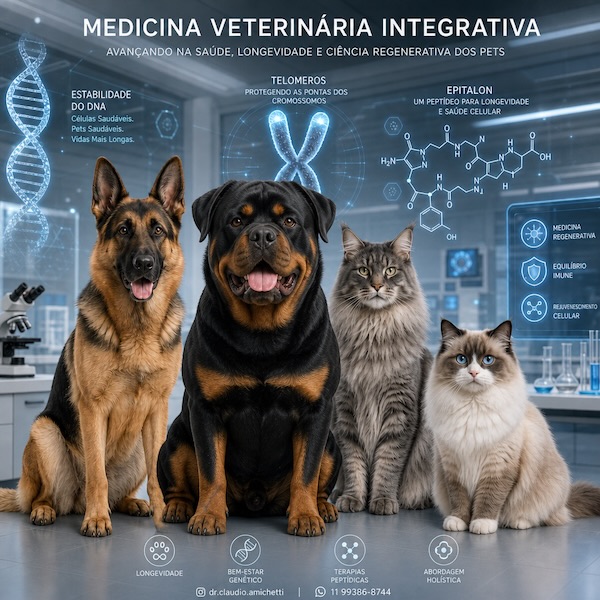
BIOQUÍMICA DA LONGEVIDADE FELINA E CANINA: MANEJO TELOMÉRICO E O PAPEL DO EPITALON
Abordagem Integrativa no Tratamento de Pacientes Geriátricos, Oncológicos e com Doenças Crônicas
11 de junho de 2026
Autores: Dr. Cláudio Amichetti Júnior (CRMV-SP 75.404 VT); Dr. Gabriel Amichetti (CRMV-SP 45.592 VT)
Afiliação: Petclube – Medicina Veterinária Integrativa, São Paulo, SP, Brasil.
2025
1. Resumo
O avanço da medicina veterinária nas últimas décadas proporcionou um aumento significativo na expectativa de vida de cães e gatos. No entanto, esse fenômeno gerou o chamado paradoxo da longevidade: o prolongamento da vida cronológica sem a correspondente preservação da autonomia funcional. Pacientes sêniores frequentemente enfrentam um declínio multissistêmico caracterizado por neoplasias, degenerações articulares e disfunções cognitivas. A medicina veterinária integrativa propõe uma mudança de paradigma, focando na saúde celular e na manutenção da homeostase genômica. Este artigo explora os mecanismos bioquímicos do envelhecimento celular, com ênfase no manejo dos telômeros e na utilização de peptídeos biorreguladores, como o Epitalon, para promover uma senescência saudável e funcional em pequenos animais.
2. Fundamentação Bioquímica
2.1. Instabilidade Genômica e Encurtamento Telomérico
Os telômeros são complexos nucleoproteicos localizados nas extremidades dos cromossomos eucarióticos, compostos por repetições de sequências de DNA (TTAGGG em mamíferos) e proteínas do complexo shelterina. Sua função primordial é proteger o genoma contra a degradação e fusões cromossômicas. Em cães e gatos, assim como em humanos, a cada divisão celular ocorre o encurtamento progressivo dessas estruturas devido à incapacidade da DNA polimerase de replicar a extremidade 3' (o problema da replicação terminal). Quando os telômeros atingem o Limite de Hayflick, a célula entra em um estado de parada irreversível do ciclo celular, conhecido como senescência replicativa, comprometendo a capacidade regenerativa dos tecidos.
2.2. O Fenótipo SASP e o 'Inflammaging' na Clínica Veterinária
Células senescentes não são metabolicamente inertes; elas desenvolvem o Fenótipo Secretor Associado à Senescência (SASP). Este fenótipo é caracterizado pela secreção exacerbada de citocinas pró-inflamatórias (IL-1, IL-6, TNF-α), quimiocinas e metaloproteinases de matriz. Na clínica veterinária, esse processo sustenta o inflammaging — uma inflamação crônica de baixo grau que atua como substrato para doenças degenerativas e oncológicas. A presença de células senescentes no microambiente tumoral, por exemplo, pode acelerar a progressão neoplásica e a angiogênese, tornando o manejo da senescência uma estratégia crucial na oncologia veterinária.
2.3. Disfunção Mitocondrial e Estresse Oxidativo
A teoria mitocondrial do envelhecimento postula que o acúmulo de danos ao DNA mitocondrial (mtDNA) por espécies reativas de oxigênio (EROs) resulta em uma produção ineficiente de ATP e maior escape de elétrons. Esse ciclo vicioso de estresse oxidativo acelera o desgaste telomérico, uma vez que as sequências ricas em guanina dos telômeros são altamente suscetíveis à oxidação. Em pacientes geriátricos, a queda na produção de antioxidantes endógenos, como a glutationa e a superóxido dismutase, agrava a disfunção mitocondrial, levando à falência energética celular e morte programada.
3. Epigenética e Metilação
A epigenética refere-se a modificações heriditárias na expressão gênica que não alteram a sequência do DNA. Um dos mecanismos mais estudados é a metilação do DNA. O ciclo da metilação é vital para a síntese de neurotransmissores, reparo de DNA e detoxificação hepática. O marcador clínico central deste processo é a homocisteína; níveis elevados indicam falhas na remetilação ou transulfuração. Em gatos, que possuem particularidades metabólicas como carnívoros estritos, a deficiência de doadores de metil pode levar a quadros graves de lipidose hepática e degeneração neurológica. A suplementação com Metilfolato, Metilcobalamina (B12) e S-adenosilmetionina (SAMe) é fundamental para manter a estabilidade epigenética e reduzir o risco de silenciamento de genes supressores de tumor.
4. Terapêutica Biomolecular e Protetores de Telômeros
4.1. Epitalon (Epithalon): O Peptídeo da Longevidade
O Epitalon é um tetrapeptídeo sintético (Ala-Glu-Asp-Gly) baseado na epitalamina, um extrato da glândula pineal. Seu mecanismo de ação principal é a ativação da enzima telomerase, permitindo o re-alongamento dos telômeros e a restauração do potencial replicativo celular. Além disso, o Epitalon atua como um potente regulador da pineal, otimizando a produção de melatonina endógena e resincronizando os ritmos circadianos, frequentemente alterados em cães com disfunção cognitiva.
4.2. Ativadores de Telomerase e Moduladores Metabólicos
O uso de fitoterápicos como o Astragalus membranaceus (especificamente o Cicloastragenol) tem demonstrado capacidade de induzir a expressão da telomerase em linfócitos. Paralelamente, a estimulação da produção de Irisinaatravés de exercícios físicos adaptados e fisioterapia promove a neuroproteção e o alongamento telomérico sistêmico. No campo da bioenergética, o NAD+ (Nicotinamida Adenina Dinucleotídeo) é essencial para a atividade das Sirtuínas(SIRT1-7), enzimas que regulam o reparo do DNA e a biogênese mitocondrial. A suplementação com precursores de NAD+ é uma estratégia emergente para reverter o declínio metabólico em pacientes idosos.
4.3. Senolíticos, Senomórficos e Suporte Antioxidante
A eliminação seletiva de células senescentes através de agentes senolíticos, como a Quercetina e a Fisetina, reduz a carga inflamatória do organismo. Agentes senomórficos, como a Curcumina, modulam o SASP sem necessariamente matar a célula. O suporte é complementado por uma rede antioxidante robusta:
- Coenzima Q10: Proteção da cadeia transportadora de elétrons mitocondrial.
- Ácido Alfa-Lipóico: Antioxidante anfipático que recicla as vitaminas C e E.
- Melatonina: O mais potente antioxidante mitocondrial e oncostático.
- Vitamina D (Hormônio D): Modulador imunológico e regulador da transcrição gênica.
5. Protocolos Sugeridos
A implementação clínica deve seguir uma progressão lógica para garantir a segurança e eficácia metabólica do paciente veterinário.
| Fase | Objetivo Principal | Intervenções Bioquímicas |
|---|---|---|
| 1. Detoxificação e Estabilização | Reduzir carga tóxica e inflamação sistêmica (SASP). | N-acetilcisteína (NAC), Silimarina, Curcumina, Ômega-3 (EPA/DHA). |
| 2. Nutrição Celular e Metilação | Otimizar o reparo de DNA e a função mitocondrial. | Complexo B metilado, SAMe, CoQ10, Magnésio Quelato, NAD+. |
| 3. Ativação Telomérica | Reversão da senescência e alongamento de telômeros. | Epitalon (protocolos cíclicos), Astragalus, Vitamina D, Melatonina. |
6. Conclusão
A medicina veterinária do amanhã exige um olhar profundo sobre a bioquímica subcelular. Tratar o indivíduo através do tratamento da célula não é mais uma perspectiva futurista, mas uma necessidade clínica imediata. O manejo dos telômeros, a modulação epigenética e o uso estratégico de peptídeos como o Epitalon oferecem ferramentas poderosas para combater as doenças da senescência. Ao focar na biologia do envelhecimento, o médico veterinário integrativo não apenas prolonga a vida, mas assegura que cada ano adicional seja vivido com dignidade, vitalidade e plena função biológica.
Referências Bibliográficas
FOSSEL, M. The Telomerase Revolution: The Enzyme That Holds the Key to Human Aging and Will Soon Lead to Longer, Healthier Lives. BenBella Books, 2015.
SINCLAIR, D. A.; LAPLANTE, M. Lifespan: Why We Age—and Why We Don't Have To. Atria Books, 2019.
KHAVINSON, V. K. Peptides and Ageing. Neuro Endocrinology Letters, 2002.
BLACKBURN, E. H.; EPEL, E. S. The Telomere Effect: A Revolutionary Approach to Living Younger, Healthier, Longer. Grand Central Publishing, 2017.
DISCLAIMER
Aviso Legal e Responsabilidade Técnica
- Natureza Experimental: Embora existam décadas de estudos (principalmente na escola russa de gerontologia) e evidências robustas em modelos murinos (ratos), o uso do Epitalon em cães e gatos ainda é considerado experimental em muitas jurisdições.
- Ausência de Registro: No Brasil, o Epitalon não possui registro na ANVISA ou no MAPA para uso clínico comercial. Sua utilização deve ocorrer sob a responsabilidade direta do médico veterinário, preferencialmente em contextos de pesquisa ou protocolos de medicina personalizada.
- Individualização do Tratamento: Os protocolos e dosagens sugeridos em literatura são referenciais. A aplicação deve ser precedida de uma avaliação clínica completa, incluindo exames laboratoriais (Homocisteína, Vitamina D, perfil renal e hepático) para garantir a segurança do paciente.
- Não Substituição: A terapia biomolecular e o manejo telomérico são abordagens complementares. Elas não substituem os tratamentos convencionais para patologias instaladas, mas atuam na otimização do terreno biológico e na resiliência celular.
- Supervisão Profissional: Este conteúdo é destinado exclusivamente a profissionais da área da saúde animal. Tutores não devem administrar nenhuma das substâncias citadas sem a prescrição e o acompanhamento de um médico veterinário capacitado em medicina integrativa.
Resumindo
O foco deste material é fornecer embasamento bioquímico, informação e estudopara a prática da medicina do amanhã, visando a longevidade funcional. A decisão terapêutica final e o monitoramento de possíveis efeitos adversos são de inteira responsabilidade do profissional assistente.
Ver essa foto no Instagram
- ENRIQUECIMENTO AMBIENTAL E ATIVIDADE FÍSICA COMO FERRAMENTAS PARA O DESENVOLVIMENTO E A NORMALIDADE DO COMPORTAMENTO ANIMAL NA VETERINÁRIA
- PERFIL FAKE DO PETCLUBE 🚨 ATENÇÃO, AMIGOS E AMIGAS 🚨BANDIDAGEM NO BRASIL
- O Lobo, a Trófica Evolutiva e a Quebra da Nutrição Moderna: Uma Análise Biológica, Bioquímica e Histórica com Força Argumentativa na Criação e Alimentação Canina
- DIFERENCIAÇÃO ENTRE SÍNDROME DO INTESTINO IRRITÁVEL (IBS) E SUPERCRESCIMENTO BACTERIANO DO INTESTINO DELGADO (SIBO) EM CÃES E GATOS: FISIOPATOLOGIA, DIAGNÓSTICO E MANEJO TERAPÊUTICO
- SEU GATO VOMITA BOLAS DE PELO… E ISSO PODE NÃO SER TÃO “NORMAL” QUANTO PARECE 🐱⚠️
- Medicina Veterinária Integrativa e Translacional: Do Erro Histórico dos Cereais à Homeostase Intestinal
